今日美国关注邹市明奇迹Once forbidden in China, boxing a big hit
BEIJING — From 1959 until 1986, boxing was a forbidden sport in China, as Mao Zedong banned it because it was too violent and ruthless and didn't represent Chinese ideals.
Clearly, those days are long gone.
Tuesday night (Tuesday morning, ET), Zou Shiming danced into the Olympic boxing arena wearing a golden robe, matching gold shoes and a reigning world champion's confident smile.
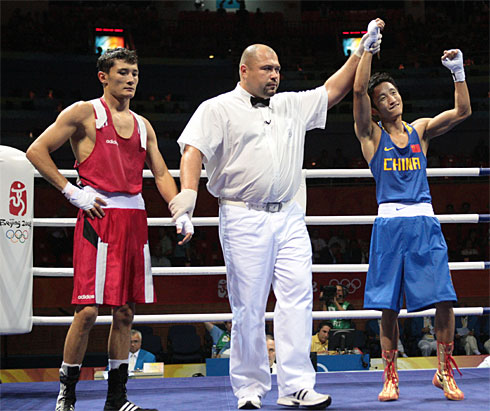
China's Zou Shiming, right, wearing his custom gold footwear, is declared the winner after defeating Kazakhstan's Birzhan Zhakypov. By Jacques Demarthon, AFP/Getty
Zou mugged for television cameras and timed the pace of his Muhammad Ali shuffle to the snug stride of the mini-dressed woman who led him to the ring.
In a page right out of the Vegas fight scene, the woman wore knee-high white leather boots and carried a sign that proclaimed what everyone inside Workers' Gymnasium already knew: Zou is from China.
Zou cut through Kazakhstan opponent Birzhan Zhakypov tidily, scoring a 9-4 victory in their light flyweight quarterfinal, then made a great show of pointing to the Chinese flag on his singlet as he went through his ceremonial bows to the crowd.
Afterward, he addressed only the topic of his new, glittering footwear before disappearing down a hallway.
"They are specially made for me," Zou said of the gold shoes. "I like this color."
For Zou, 27, to have a successful Olympics, the medal he wins will have to match those shoes. His bronze from 2004 is the only medal China has won in boxing at the Olympics, and he raised expectations by winning the 2005 and 2007 world amateur titles.
But even if Zou underachieves, China is assured of having its most successful Olympics in boxing at the same time that the USA is flirting with having its worst in more than a half-century.
The only U.S. boxer to advance to the semifinals is heavyweight Deontay Wilder, meaning this could be America's worst medal haul in the sport since 1948.
But, with no apologies to Mao, four Chinese fighters are advancing to the semifinals, where they're all guaranteed at least a bronze. Zou had forecast this success in an interview with The New Yorker, where he addressed his nation's rise in the sport.
"Opponents looked down on Chinese players before," he said. "They were happy to take on a Chinese boxer, because we were too weak."
When light heavyweight Zhang Xiaoping advanced to the semis, the arena emptied.
"It's not so surprising," Zou's coach, Zhang Chuanliang said of China's success. "We predicted much more. Chinese boxers are fast, agile and smart."
After a victory against a French opponent Saturday, Zou gloated somewhat when he said, "Because this is in China, I make him very nervous. It is very stressful."
Zou's story also is a twist on the stereotypical one of American boxers punching their way out of the inner city.
Zou grew up Guizhou, one of China's poorer provinces. His hometown of Zunyi was a stop on the Long March, the retreating trek of nearly 6,000 miles beginning in 1934 and made by defeated communists, including Mao.
Suppose any of them were wearing gold shoes?
By Tom Weir, USA TODAY
美媒体关注邹市明奇迹 没人再小看中国拳击
作者:brwzc487 TOM体育
北京时间8月20日消息:中国拳手邹市明在上届雅典奥运会上取得了一枚宝贵的铜牌,创造了中国拳击的历史。而在这次的北京奥运会上,中国拳击队更是创纪录的有4人跻身不同级别的四强行列。中国在拳击这冷门项目上的突飞猛进,也引起了拳击传统强国美国的关注。
美国著名媒体《今日美国》今天就对中国的拳击运动发展进行了报道,文章不仅对中国运动员在本届奥运会上的出众表现大加赞赏,同时也为美国队敲响了警钟。
该文表示,27岁的邹市明是中国拳击手的杰出代表,他在雅典奥运会上就夺得了一枚铜牌,并有机会在北京更进一步。自他夺得2005及2007年世锦赛冠军后,邹市明便成为中国队在奥运会上夺金的最大希望。
不过,即使邹市明未能如愿夺冠,中国也已经创造了他们在奥运会上的最辉煌战绩。除邹市明外,还有三名拳手闯进了不同级别的半决赛。由于拳击项目不设三四名比赛,这意味着中国将至少能得到4枚铜牌。
而与此同时,美国拳击队却经历了半个多世纪以来最糟糕的一届奥运会。只有德恩特-维尔德一人在重量级的比赛中进入了半决赛,这也是自1948年来,美国在该项目上夺得奖牌最少的一次。
对于中国拳击手们所取得的成功,邹市明认为:“以前对手们都看不起中国的拳击手。当他们知道将和中国拳手对阵时通常都会很高兴,他们认为我们非常软弱。但现在情况已经完全不一样了。”
邹市明的教练张传良则表示:“现在我们的成功并不令我意外。因为中国的拳击手速度更快,更灵活,更聪明。”